.png)
Byzantine Empire Dress: Why Ancient Fashion Still Feels So Powerful
- Jan 26
- 4 min read

Byzantine Empire Dress Was Never “Just Clothing”
Let’s talk about Byzantine Empire dress, because this wasn’t fashion in the casual sense — it was politics, religion, status, and spectacle all stitched together.
While the western Roman Empire collapsed in the 5th century, the eastern half — centered in Constantinople (modern-day Istanbul) — didn’t just survive, it thrived for another thousand years. And with that longevity came one of the most visually striking fashion cultures the world has ever seen.
Byzantine clothing wasn’t designed to blend in. It was meant to announce power, radiate divine authority, and make sure everyone knew exactly where you stood in society the moment you walked into a room.

How the Byzantine Empire Became a Fashion Powerhouse
Constantinople sat at the crossroads of the Silk Road, the Mediterranean, and routes stretching into Asia and Eastern Europe. That meant access to:
Exotic silks
Rare gemstones
Precious metals
Advanced textile techniques
By the time Emperor Justinian and Empress Theodora ruled in the 6th century, the Byzantine Empire had become a global luxury hub. Their reign produced iconic architecture like the Hagia Sophia — and equally iconic fashion imagery, especially in mosaics like those at San Vitale in Ravenna.
Those mosaics are basically ancient fashion editorials.
Everyday Byzantine Empire Dress: Tunics, Layers, and Texture
Despite all the glamour, the foundation of Byzantine Empire dress was surprisingly simple.
Most people — across social classes — wore T-shaped tunics, a design inherited from Greek and Roman traditions. The magic was in the layers and details.
A typical outfit included:
Tunica interior: a linen under-garment, practical and washable
Dalmatic: a long-sleeved tunic worn over it
Palla or shawl: draped for warmth and elegance
From there, decoration did the talking. Even modest garments could feature:
Embroidered panels
Silk inserts
Pearls and beads
Colored ribbons or girdles
This layering system made Byzantine fashion adaptable — but also visually rich.

Silk Changed Everything
If there’s one material that defines Byzantine Empire dress, it’s silk.
Legend says Justinian smuggled silkworms out of China via monks, breaking China’s monopoly and launching Byzantium as Europe’s silk capital. Whether the story is romanticized or not, the result is real: Byzantine silk became legendary.
Silk was:
An economic weapon
A diplomatic gift
A visual marker of elite status
Western kings literally paid gold for it. For centuries, Byzantine silk symbolized refinement, power, and divine favor — until Italian silk production finally caught up in the late medieval period.

Patterns, Panels, and Power Signals
Byzantine textiles loved repetition and symbolism. Common patterns included:
Circular medallions
Geometric shapes
Animals, plants, and Christian motifs
One of the most important details was the tablion — a decorative panel sewn onto garments to indicate rank or office. Think of it as an ancient badge of authority.
Clothing in Byzantium wasn’t just expressive — it was administrative. You could literally read someone’s job and status by their outfit.

Imperial Byzantine Dress: Maximum Drama
Now let’s get into the real showstoppers.
Imperial Byzantine Empire dress took the same tunic base and turned it into pure spectacle using:
Heavy silk embroidery
Gold and silver threads
Pearls, gemstones, and enamel
The most iconic garment was the loros — a long, jewel-encrusted strip of fabric wrapped around the body in a precise, symbolic way. Its shape referenced the Christian monogram XP, reinforcing the idea that imperial power was divinely ordained.
Add to that:
Maniakis collars (wide, jewel-studded neckpieces)
Flowing cloaks like the chlamys or paludamentum
And yes — the legendary imperial purple.


Why Purple Meant Everything
Purple dye was made from thousands of sea snails and was so rare it became exclusive to the imperial family.
Being “born in the purple” (porphyrogennetos) wasn’t metaphorical — it was literal proof of divine lineage and political legitimacy.
As the dye aged, it shifted from red-purple to blue-purple, symbolizing ancestral authority. Wearing it without permission could get you executed. No exaggeration.
Hair, Jewelry, and Finishing Touches
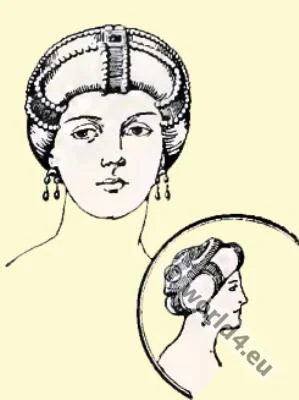
Women styled their hair with pins made of bone, metal, or shell. Married women veiled their hair, while aristocrats in the 6th century favored high, padded styles that framed the face like a halo — famously worn by Empress Theodora.
Jewelry was abundant and stunning:
Gold filigree earrings
Cabochon gemstones
Bracelets, bangles, and signet rings
Lapis lazuli imported all the way from Afghanistan
These weren’t accessories — they were status statements.

Why Byzantine Empire Dress Still Matters
Seen under candlelight or blazing Mediterranean sun, Byzantine garments would have shimmered, moved, and glowed — making the wearer feel almost supernatural.
That was the point.
Byzantine Empire dress wasn’t about trends. It was about authority, faith, and presence. And even today, its influence lives on in religious vestments, couture embellishment, and our fascination with fashion as power.
Ancient, yes — but never boring.


Comments