.png)
Haiti Winter Olympics Uniforms Go Viral: Stella Jean’s Hand-Painted Tribute to Resistance
- Feb 9
- 3 min read
Why the red horse, the missing revolutionary, and a “neutrality” rule turned Team Haiti’s kit into the Opening Ceremony’s biggest fashion moment

Okay friends—can we talk about how the Haiti Winter Olympics uniforms basically stole the whole Opening Ceremony? Haiti may be a tiny delegation at the Milan-Cortina Games, but their fits came in LOUD (in the most elegant way).
The designer behind the viral moment is Stella Jean, a Haitian-Italian designer based in Milan, and she didn’t just “design a uniform.” She made a wearable history lesson—then had to edit it last-minute because of Olympic rules.
First: why everyone’s talking about the Haiti Winter Olympics uniforms
These uniforms went viral for two big reasons:
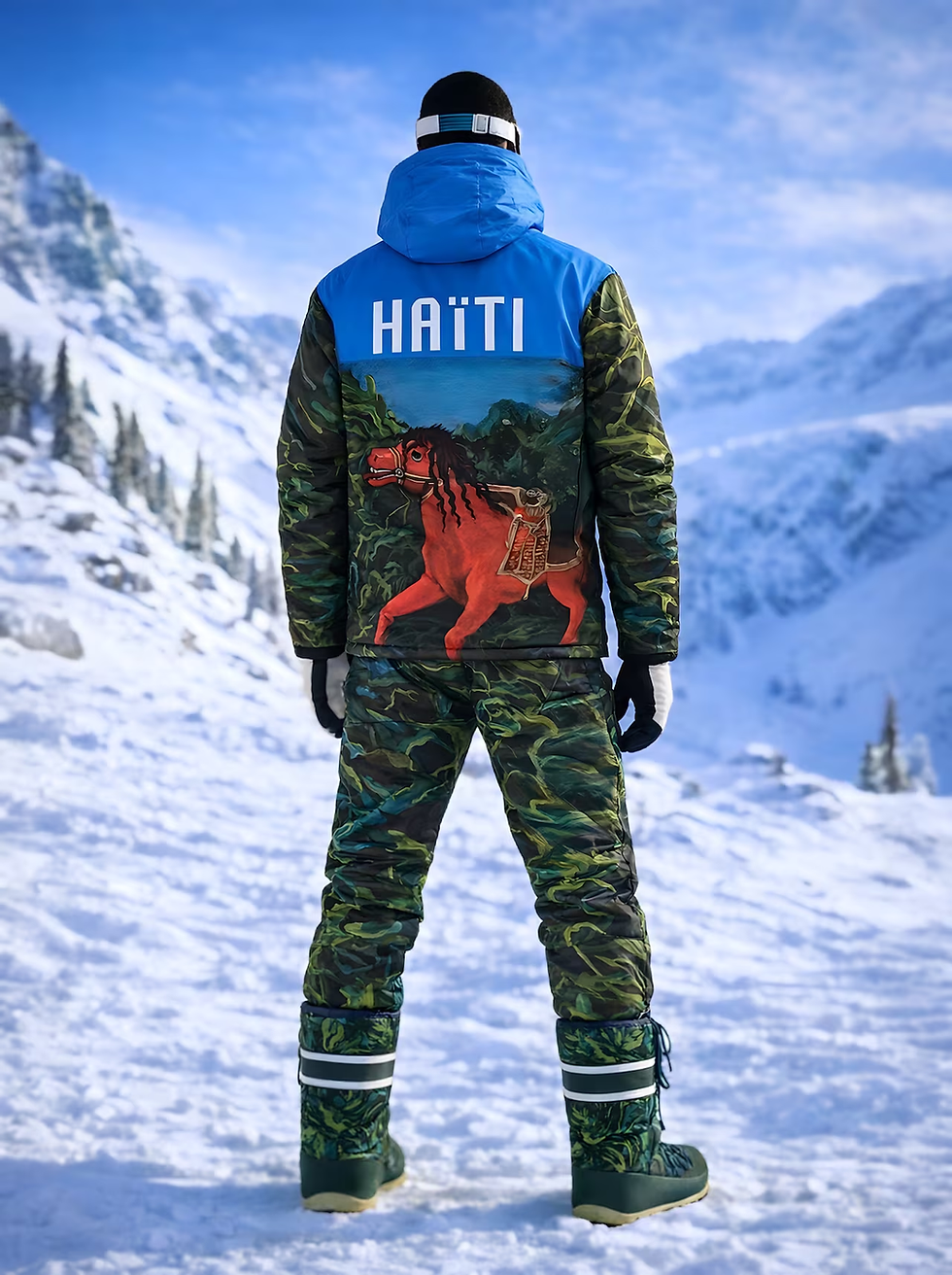
They’re literally hand-painted. Not printed. Not “inspired by.” Hand-painted by Italian artisans—so every piece is a one-of-one work of art. Stella Jean even mentioned being nervous about rain because she didn’t know how the paint would react. (Very “please don’t drizzle on my masterpiece.”)
They were redesigned after the IOC stepped in. The original concept referenced a painting showing Haitian revolutionary leader Toussaint Louverture on a red horse—then the image of Louverture had to be removed to comply with Olympic “neutrality” rules.

The red horse is the whole message
Even though Louverture’s figure was taken out, the red horse stayed—and honestly, it might be even more powerful now. It’s giving: “You can erase the portrait, but you can’t erase the story.”
The reference comes from Haitian artist Edouard Duval-Carrié, whose work features Louverture riding a red horse. Stella Jean kept the horse charging forward—now riderless—like a symbol of Haiti’s unstoppable momentum.


The IOC rule that caused the change (in plain language)
The Olympics has a rule (often discussed as Rule 50.2) that basically says no political, religious, or racial propaganda is allowed in Olympic venues. That’s why the portrait got flagged.
And here’s the part that feels messy: the Olympics is already a giant celebration of national identity (flags, anthems, “Parade of Nations”), so “neutrality” can get… complicated fast.

The symbolism is chef’s kiss
Stella Jean didn’t stop at the horse. The details are packed with meaning—like she’s telling Haiti’s story through accessories and tailoring:
A Haitian tignon (headwrap/turban)—a symbol tied to women being forced to cover their hair under colonial rule, but transforming that into pride and art.
Big pockets inspired by market women—basically honoring the people who keep daily life and the economy moving.
Hoop earrings (Creole-style) as a nod to heritage and what was historically allowed/kept.
This is why the Haiti Winter Olympics uniforms don’t feel like “merch.” They feel like identity.
A quick Haiti history refresher (because it matters here)
Toussaint Louverture was a major leader of the Haitian Revolution. He was imprisoned in France and died in 1803—right before Haiti became the world’s first Black republic in 1804.
So when Stella Jean builds a uniform around that legacy, it’s not random. It’s Haiti showing up on a global stage and saying: we’re still here.
Why this hit people so hard right now
Haiti has been going through extremely difficult conditions in recent years, and Stella Jean’s message (and the delegation’s presence) lands as resilience—not just sport. That contrast is exactly why the visuals cut through the noise: a small team, a massive story, and a uniform that refuses to be ignored.
The takeaway
If you only remember one thing: the Haiti Winter Olympics uniforms prove fashion can be more than “cute.” It can be proof of existence. It can carry memory. It can turn a 9-second walk into a statement.
Comments