.png)
Dress Like a Byzantine Empress: How Byzantine Art Took Over Fashion Collections
- Jan 26
- 4 min read

From Coco Chanel to Dolce & Gabbana, here’s how Byzantine art keeps inspiring fashion’s most over-the-top, regal moments.
Why Byzantine Art Fashion Feels So Powerful
Let’s be honest — if you’re going to dress like royalty, you might as well go full Byzantine empress. When we talk about Byzantine art fashion, we’re really talking about drama, symbolism, gold, gemstones, and that unmistakable feeling of power stitched into every seam.
This obsession didn’t come out of nowhere. It actually traces back to Empress Theodora, the most iconic fashion figure of the Byzantine Empire, and one very important piece of jewelry owned by Coco Chanel: the legendary Ravenna cuff from the 1930s. That moment quietly opened the floodgates for Byzantine mosaics, religious symbolism, and imperial silhouettes to enter modern fashion.
And once designers got a taste of that level of opulence? There was no turning back.
Coco Chanel: The Original Byzantine Muse

Before runway shows went full maximalist, Coco Chanel was already experimenting with Byzantine influence — especially through jewelry.
Working with Fulco di Verdura, Chanel commissioned cuffs, brooches, and crosses inspired by the glittering mosaics of San Vitale in Ravenna. These weren’t subtle pieces. They were bold, enamel-heavy, gem-studded statements that echoed imperial Byzantine ornamentation.
What made it genius was contrast: Chanel paired this ancient grandeur with modern, pared-down silhouettes. That balance became the blueprint for Byzantine art fashion moving forward.
Alexander McQueen: Medieval Drama Meets Couture

Alexander McQueen’s Fall 2010 Ready-to-Wear collection was one of the most hauntingly beautiful examples of Byzantine art fashion on the runway.
Inspired by the Middle Ages, McQueen sent out gowns drenched in gold embroidery, jewel-like detailing, and floor-length capes reminiscent of the paludamentum, the ceremonial cloak worn by Byzantine rulers. These looks didn’t just reference history — they felt ceremonial, almost sacred.
Knowing this was McQueen’s final collection makes it even more powerful. The garments felt like relics from a lost empire, designed for modern empresses who weren’t afraid of intensity.
Chanel’s “Paris-Byzance”: When Coco Became Theodora

Fast-forward to Pre-Fall 2011, and Karl Lagerfeld fully embraced Byzantine art fashion with Chanel’s Paris-Byzance collection.
“Coco Chanel is the new Theodora,” Lagerfeld famously said — and honestly, he wasn’t wrong.
The collection featured:
Deep jewel tones (purple, black, gold)
Mosaic-style embroidery
Heavy gem embellishment
Tiara-like headpieces and regal hair styling
The silhouettes referenced Byzantine empresses Irene and Theodora, while still feeling unmistakably Chanel. It was rich, theatrical, and unapologetically luxurious — a love letter to Byzantine splendor filtered through Parisian chic.
Dolce & Gabbana: Peak Byzantine Fantasy
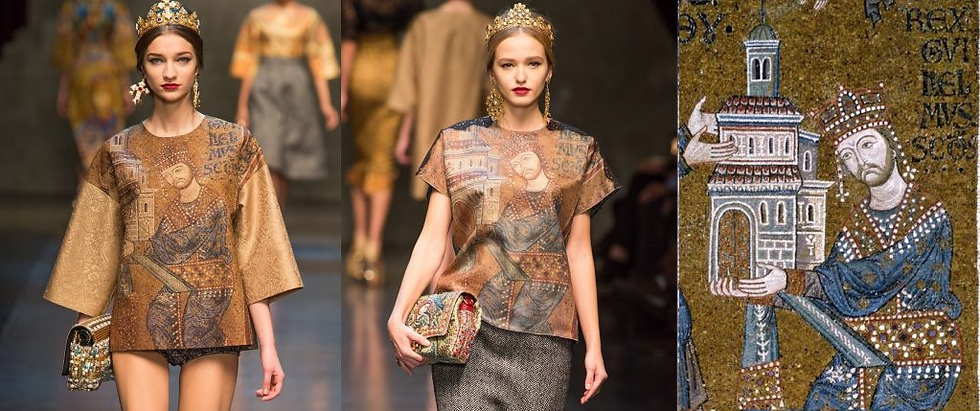
If we’re crowning one runway moment as the ultimate Byzantine art fashion spectacle, it’s Dolce & Gabbana Fall/Winter 2013 — no contest.


Designers Domenico Dolce and Stefano Gabbana went straight to the source, using actual mosaics from Sicily’s Monreale Cathedral as prints and embroideries. Think angels, saints, gold tesserae, and sacred iconography transformed into wearable art.
The collection featured:
Crown headpieces
Cross earrings and pendants
Gem-encrusted corsets
Mosaic-printed dresses and handbags
Shoes that looked like relics
This wasn’t subtle inspiration — it was full immersion. Head to toe. From the clothes to the accessories, Dolce & Gabbana delivered a runway that felt like stepping into a Byzantine cathedral… with heels.
Valentino: Softening Byzantine Grandeur

Valentino’s Spring 2016 Couture collection offered a more romantic, ethereal take on Byzantine art fashion.
Designers Maria Grazia Chiuri and Pierpaolo Piccioli drew inspiration from Mariano Fortuny, whose early-20th-century gowns reimagined ancient Greek and Byzantine silhouettes. Flowing velvet, sheer layers, long capes, and delicate gold embellishments created looks that felt regal without being rigid.
This was Byzantine influence through a softer lens — less armor, more poetry. Still powerful, just quieter.
Jewelry: Where Byzantine Influence Never Left

While fashion cycles come and go, Byzantine influence has never left jewelry.
Verdura’s Byzantine collection — inspired by Ravenna mosaics — set the standard with crosses, enamel work, cabochon stones, and bold color contrasts. Today, those same motifs live on at:
Verdura
Yves Saint Laurent
Givenchy
Dolce & Gabbana
Valentino
Byzantine art fashion thrives in jewelry because it was always about symbolism, craftsmanship, and storytelling — qualities that never go out of style.
Why Designers Keep Coming Back to Byzantine Art Fashion
Because it offers something fashion is always chasing:
Power
Drama
Meaning
Visual impact
Byzantine art fashion isn’t minimalist. It doesn’t whisper. It commands attention — and in an era where fashion is about identity and storytelling, that kind of presence is irresistible.
So yes, if you’ve ever wanted to dress like an empress, history says: go for it.


Comments